
Imagine searching for your company and discovering that its strongest result is not your official website. It is an article, profile, document or community post hosted on someone else’s domain.
At first, this looks like a success. The page ranks, people can discover the brand and the host website already has search authority. But there is an important weakness: the business does not control the platform, search snippet, advertising environment or long-term availability of that page.
A modern Parasite SEO Course should examine this tension between visibility and ownership. It should teach marketers how to benefit from third-party discovery while preventing an external platform from becoming the centre of their digital identity.
The Real Problem Is Not the Ranking
A third-party page ranking above a company website does not automatically mean something has gone wrong. Established publishing platforms can sometimes earn visibility faster because they are regularly crawled, widely referenced and already trusted for certain subjects.
The problem begins when customers can learn more from the external page than from the official website.
This may happen when the owned website has:
- Thin or generic service pages
- Weak internal linking
- Unclear business information
- Limited evidence of experience
- Poorly targeted titles and headings
- No answer to the searcher’s actual question
- Slow indexing of recently published content
- Complicated navigation
- Weak mobile conversion options
The third-party result is therefore not only an opportunity. It can expose weaknesses in the website the business owns.
A Parasite SEO Course Should Begin with SERP Ownership
Most courses start by identifying high-authority publishing websites. A stronger course should begin by mapping who controls the results for important brand and commercial searches.
A SERP-ownership audit should record:
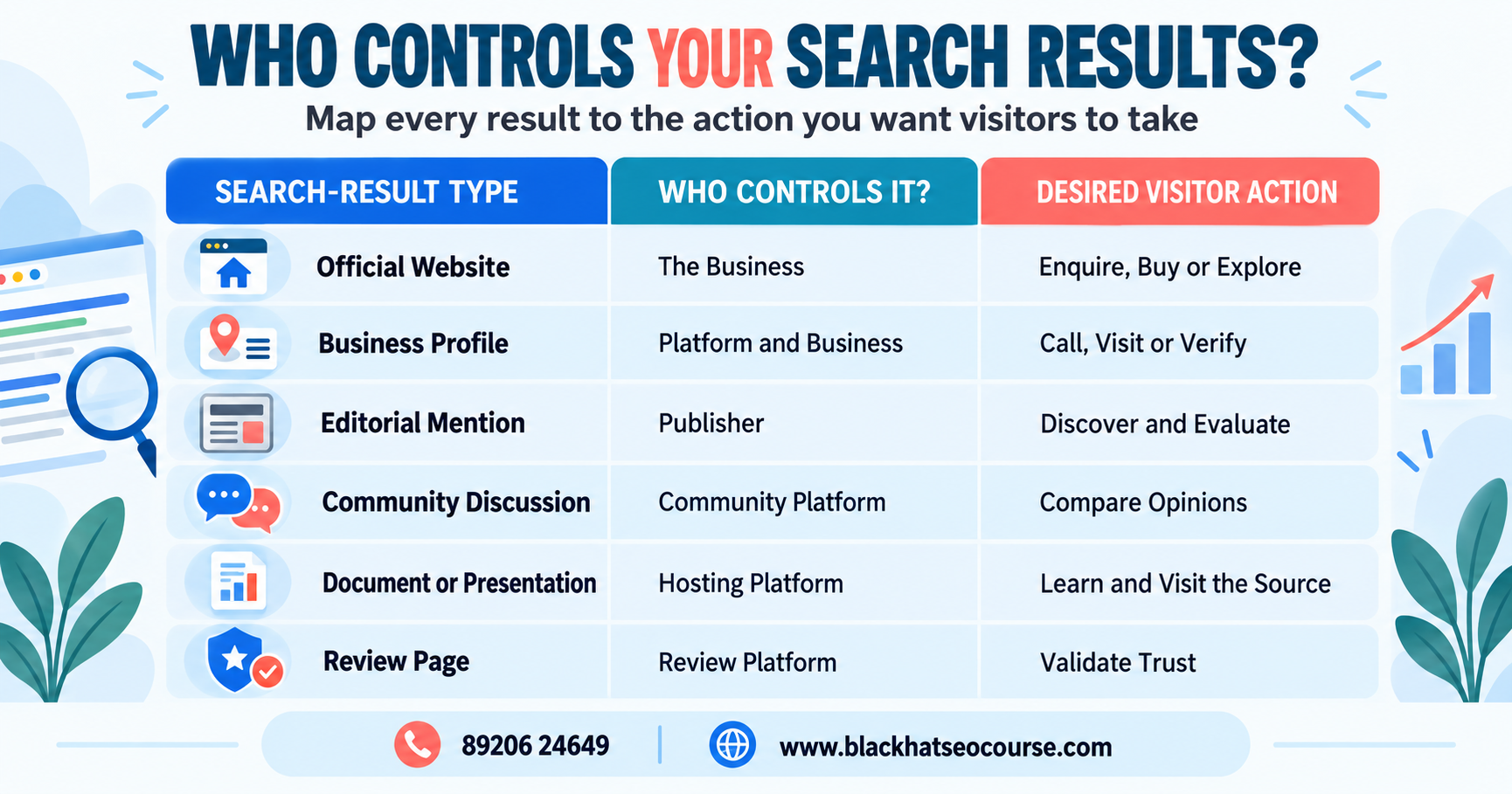
This reveals whether the brand has a balanced search presence or depends too heavily on assets it cannot manage completely.
Teach Platform Purpose, Not Platform Lists
A list of “best parasite SEO websites” becomes outdated quickly. Policies change, accounts are restricted and platforms may alter how external links or promotional content are treated.
Training should instead teach learners to assign a clear purpose to each platform.
An industry publication may be suitable for expert commentary. A presentation platform may support a visual research summary. A professional community may be useful for answering a specific operational question.
The decision should depend on:
- Audience relevance
- Accepted content formats
- Editorial standards
- Search visibility for the subject
- Account ownership
- Editing access
- Link and promotional policies
- Measurement options
- Brand-safety considerations
A powerful domain is not automatically the correct publishing environment.
The Course Must Address Search-Result Displacement
Third-party publishing can unintentionally create competition for the official website. If an external article targets the same query and offers nearly identical information, Google may prefer the established host.
This produces a difficult situation: the campaign appears successful because something ranks, but the business sends potential customers through an experience it cannot fully control.
Before publishing, decide what each page should accomplish.
For example:
- The external article introduces the problem.
- The owned guide provides the complete methodology.
- The service page explains the commercial solution.
- The case study provides evidence.
- The contact page supports conversion.
This creates progression instead of duplication.
Information Gain Should Decide What Gets Published
Rewriting the same article for multiple websites is not a visibility strategy. Every external asset should contribute new information.
A useful Parasite SEO Course should train learners to create different evidence formats, such as:
- A short industry observation
- A comparison based on defined criteria
- A visual framework
- A checklist
- An expert response
- A small original data analysis
- A case-study summary
- A common-mistakes review
Information gain gives each page a reason to exist. It also reduces the chance that several similar pages will compete for the same search intent.
Attribution Must Be Planned Before Publishing
Traffic from external platforms is frequently reported as a backlink achievement, even when nobody knows whether the placement produced meaningful business activity.
Before publication, define:
- The intended query group
- The target audience
- The page’s primary purpose
- The link destination
- The expected visitor action
- The measurement method
- The review date
- The conditions for updating or removing the content
Use permitted tracking parameters for external links and record referral visits, engaged sessions, branded searches, enquiries and assisted conversions.
If a page ranks but attracts the wrong audience, it is not delivering the intended outcome.
AEO and GEO Change the Value of Third-Party Content
External pages are no longer valuable only as rankings or backlinks. Search and generative systems may use reputable third-party information to understand a brand or compare its claims.
This makes clarity and consistency essential.
The company name, specialist information, service descriptions, operating locations and supporting evidence should not conflict across different platforms.
For AEO, the external contribution should answer a focused question clearly. For GEO, important claims should be specific, attributable and supported.
“Leading SEO experts” is a promotional phrase.
“An SEO audit separates indexing, relevance, search-result performance and conversion barriers” is a clear, explainable statement.
The second version gives readers and machines something meaningful to interpret.
Every Placement Needs an Exit Plan
A business should assume that any third-party page can eventually be modified, restricted, deindexed or deleted.
A responsible course should teach learners to:
- Save the original content and creative assets.
- Record account ownership and login responsibility.
- Maintain a list of published URLs.
- Review whether pages remain live and accurate.
- Update outdated brand or contact information.
- Avoid storing essential business information only on external platforms.
- Redirect the strategy toward owned assets if platform conditions change.
This is basic digital-asset management, yet many ranking-focused courses ignore it.
Frequently Asked Questions
What is taught in a Parasite SEO Course?
A professional course should cover third-party publishing, SERP ownership, platform selection, content differentiation, attribution, AEO, GEO, policy compliance and contingency planning.
Why can a third-party page outrank an official website?
The host may have stronger topical authority, internal distribution, backlinks or crawl frequency. The external page may also answer the query more directly than the company’s own page.
Should the external page target the same keyword as the website?
Only when their purposes are clearly different. Publishing two similar pages for the same intention can create unnecessary competition.
Can third-party publishing support GEO?
It may strengthen brand understanding when reputable sources provide consistent, verifiable information. Repeated promotional claims on low-quality platforms are unlikely to create the same value.
What is the most important success metric?
The metric should match the page’s purpose. It may be referral visits, branded-search growth, qualified enquiries, citations or assisted conversions—not merely ranking position.
Conclusion
The most useful Parasite SEO Course should not teach learners to celebrate every third-party ranking. It should help them determine who controls the customer journey, what the external page contributes and whether that visibility strengthens an asset the business owns.
A third-party result can introduce the brand, validate expertise and reach a new audience. But the official website should remain the most complete, reliable and conversion-ready source.
Want to evaluate your third-party visibility and owned-search assets?
Call or WhatsApp: 89206 24649
Website: www.blackhatseocourse.com