
Most websites do not have a “lack of SEO activity” problem. They have a diagnosis problem.
When organic growth slows, the usual response is to publish more articles, acquire more backlinks and target additional keywords. Yet adding activity to a system without identifying its constraint often makes performance worse. It creates overlapping pages, weak links, wasted crawl activity and reports filled with numbers that have little commercial meaning.
An experienced specialist approaches BlackHatSEO Services differently. The starting point is not a catalogue of tactics. It is a forensic examination of how search engines discover, interpret, compare and trust a website.
The objective is to find the precise point at which performance is being restricted—and decide whether the safest solution is technical correction, content consolidation, authority development or a controlled experiment.
Rankings Are an Output, Not a Diagnosis
A ranking decline does not explain what went wrong. It only confirms that the relationship between a website, its competitors and the search results has changed.
A proper investigation separates four different situations:
- Demand decline: Fewer people are searching for the topic.
- Visibility decline: The website appears in fewer relevant search results.
- CTR decline: Impressions remain available, but fewer users click.
- Conversion decline: Traffic continues, but enquiries or sales fall.
These situations require different responses. Link building cannot repair poor conversion tracking. Rewriting content may not recover traffic lost because search demand has fallen. A title change might improve CTR but cannot correct an indexing failure.
Professional SEO begins by classifying the loss correctly.
Build a Query-to-Outcome Map
Keyword reports often contain hundreds of unrelated phrases. Looking at them individually can hide the real pattern.
An experienced SEO specialist groups queries according to:
- Search intent
- Topic or service
- Landing page
- Location
- Device
- Customer-journey stage
- Commercial outcome
The resulting chain should be clear:
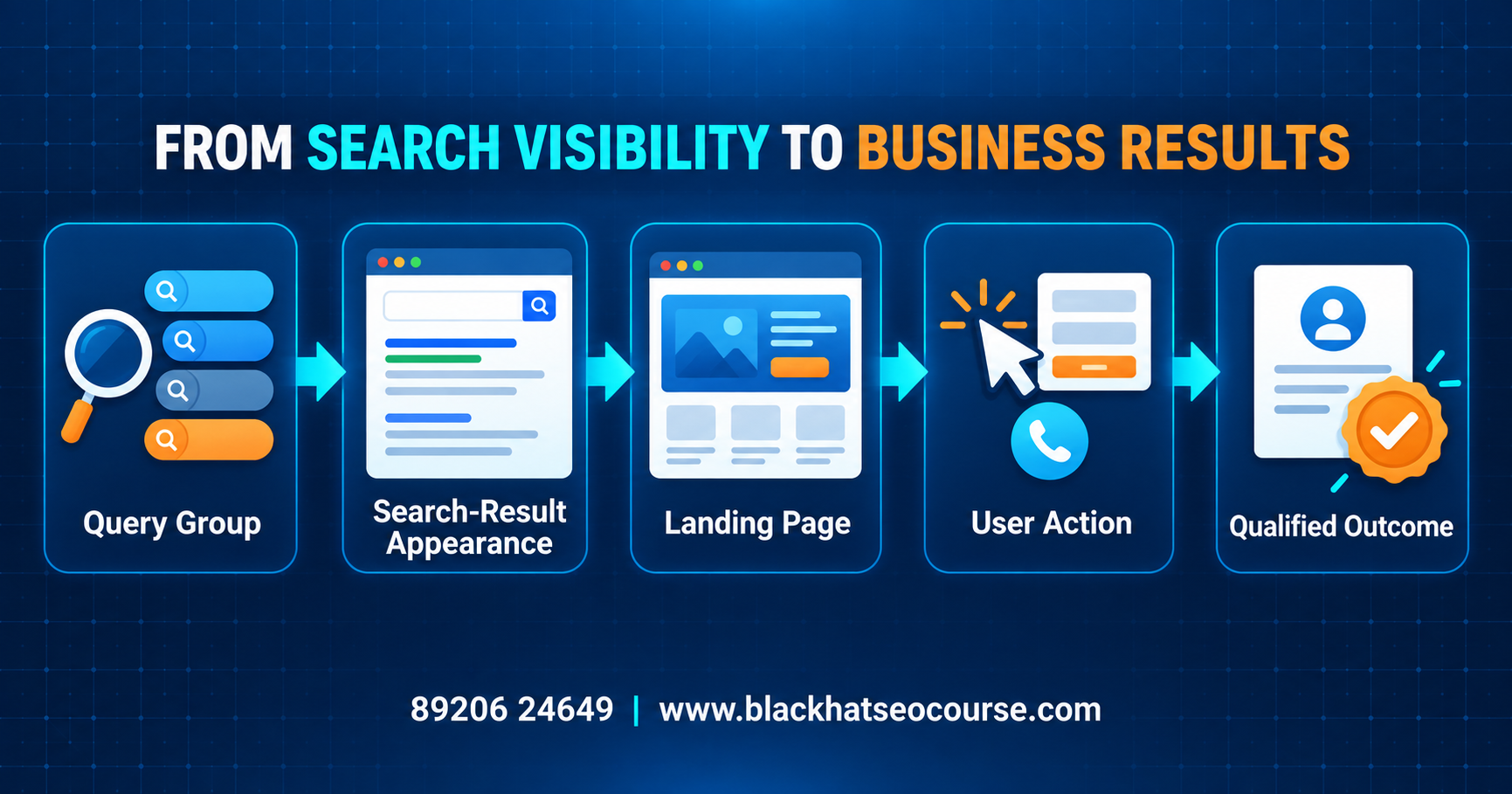
This map exposes problems that average-position reports miss. For example, a service page may rank for many informational queries but fail to attract buyers. Alternatively, several pages may compete for the same query group, causing Google to alternate between weaker and stronger URLs.
The correct solution may be consolidation rather than additional content.
Find the Dominant Ranking Constraint
A website can suffer from many imperfections, but usually only a few materially restrict its growth. The specialist’s job is to identify the dominant constraint.
Discovery Constraint
Important pages are difficult to reach because of weak internal linking, poor navigation or reliance on XML sitemaps alone.
Indexing Constraint
Google discovers the URLs but does not consistently index them because they are duplicative, low-value, incorrectly canonicalised or trapped behind technical signals.
Relevance Constraint
The page mentions the target keyword but does not satisfy the purpose behind the search. It may explain a service when users expect a comparison, calculator, local provider or transactional page.
Authority Constraint
The content is useful, but stronger competitors possess better evidence, recognised authors, relevant references and trusted industry relationships.
Presentation Constraint
The page ranks, but its title, description or visible offer fails to earn clicks. Search features, advertisements and stronger competitor messaging may reduce its traffic even when its position appears stable.
Conversion Constraint
Visitors arrive but cannot find pricing context, proof, service coverage, contact options or a convincing reason to act.
A campaign becomes efficient only after the dominant constraint is identified.
What “Advanced” SEO Should Actually Mean
Advanced SEO is frequently confused with secrecy or aggression. In reality, advanced work is distinguished by the quality of its analysis.
Useful BlackHatSEO Services should examine difficult areas such as JavaScript rendering, canonical conflicts, redirect behaviour, crawl prioritisation, template duplication, entity ambiguity and link-network risk. These services should help businesses understand complex search behaviour—not simply sell automated backlinks.
A specialist may study manipulative techniques to recognise competitor spam, investigate suspicious ranking changes or protect a website from harmful implementation. Understanding a tactic does not mean deploying it carelessly.
The business must know:
- Which asset will be changed
- Who owns and controls that asset
- What evidence supports the decision
- Which metric should respond
- How long the test will run
- What would invalidate the hypothesis
- Whether the change can be reversed
If these questions cannot be answered, the activity is not an SEO experiment. It is speculation.
Use Controlled SEO Experiments
SEO rarely provides perfect laboratory conditions, but disciplined testing can still improve decision-making.
Begin with a group of comparable pages. Apply one clearly defined change to a selected set while leaving another set unchanged where practical. Record the starting position, impressions, clicks, indexing status and conversions.
Potential tests may include:
- Rewriting titles for pages with strong impressions but weak CTR
- Consolidating overlapping articles
- Adding contextual internal links to under-discovered pages
- Improving proof and service information on commercial pages
- Updating content that has lost relevance
- Removing or neutralising low-quality legacy pages
Avoid changing titles, content, internal links, schema and page design simultaneously. If performance improves, you will not know which modification caused it.
Analyse Competitors at Page Level
Generic competitor metrics can be misleading. A high-authority domain is not automatically the best model for every keyword.
Compare the pages that actually win the target search:
- What intent do they satisfy?
- What information appears above the fold?
- How deeply do they cover the decision?
- What evidence supports their claims?
- Which internal pages reinforce the topic?
- What types of websites reference them?
- How quickly can users complete the desired action?
This analysis often reveals that a competitor is winning through better format or stronger evidence—not simply more backlinks.
Connect SEO With AI Discovery
Search visibility now extends beyond traditional rankings. AI-assisted results prefer information that can be extracted, understood and verified.
Businesses should clearly define their services, locations, expertise, authors, policies and supporting evidence. Important claims should appear near their sources rather than being separated across unrelated pages.
Original examples, named processes, accurate statistics and consistent company information create stronger signals than mass-produced definitions. This supports SEO, Answer Engine Optimisation and Generative Engine Optimisation without creating three disconnected strategies.
Reporting Should Lead to Decisions
An advanced SEO report should not merely list submissions, rankings and traffic totals. It should answer:
- What changed?
- Where did the change occur?
- Which query and page groups were affected?
- What is the most likely explanation?
- What evidence supports that explanation?
- What action should be taken next?
- How will success or failure be measured?
Reporting becomes valuable when it reduces uncertainty and guides the next investment.
Frequently Asked Questions
Can BlackHatSEO services guarantee rankings?
No specialist can guarantee a specific organic position. SEO professionals can control research, implementation and measurement, but they cannot control search algorithms or competitors.
Should a declining page always be rewritten?
No. First determine whether the loss comes from demand, indexing, CTR, competition or intent. Rewriting without diagnosis may remove content that was already performing well.
Are backlinks still important?
Relevant editorial references can strengthen discovery and authority. However, backlinks cannot compensate indefinitely for poor relevance, duplication or a weak customer experience.
How long should an SEO experiment run?
It depends on crawl frequency, traffic volume and the scale of the change. The testing period should be defined before implementation and should account for external events such as seasonality or algorithm updates.
Conclusion
The greatest advantage of an experienced SEO specialist is not access to hidden tactics. It is the ability to separate symptoms from causes.
Effective BlackHatSEO Services should uncover ranking bottlenecks, assess technical and commercial risk, design controlled changes and connect search performance with qualified outcomes. When every action has a hypothesis, an owner, a measurement method and a reversal plan, SEO becomes a disciplined growth system rather than a collection of submissions.
The question is no longer, “How much SEO work was completed?”
The better question is, “Which constraint was removed, and what measurable business result followed?”