
SEO teams often believe their next breakthrough will come from another tool. They subscribe to a rank tracker, purchase a backlink database, add an AI writing platform and install several browser extensions.
Soon, the team has more reports than answers.
One tool reports a technical error, another shows a keyword decline, and a third recommends publishing more content. The problem is no longer missing data. It is deciding which signal deserves attention.
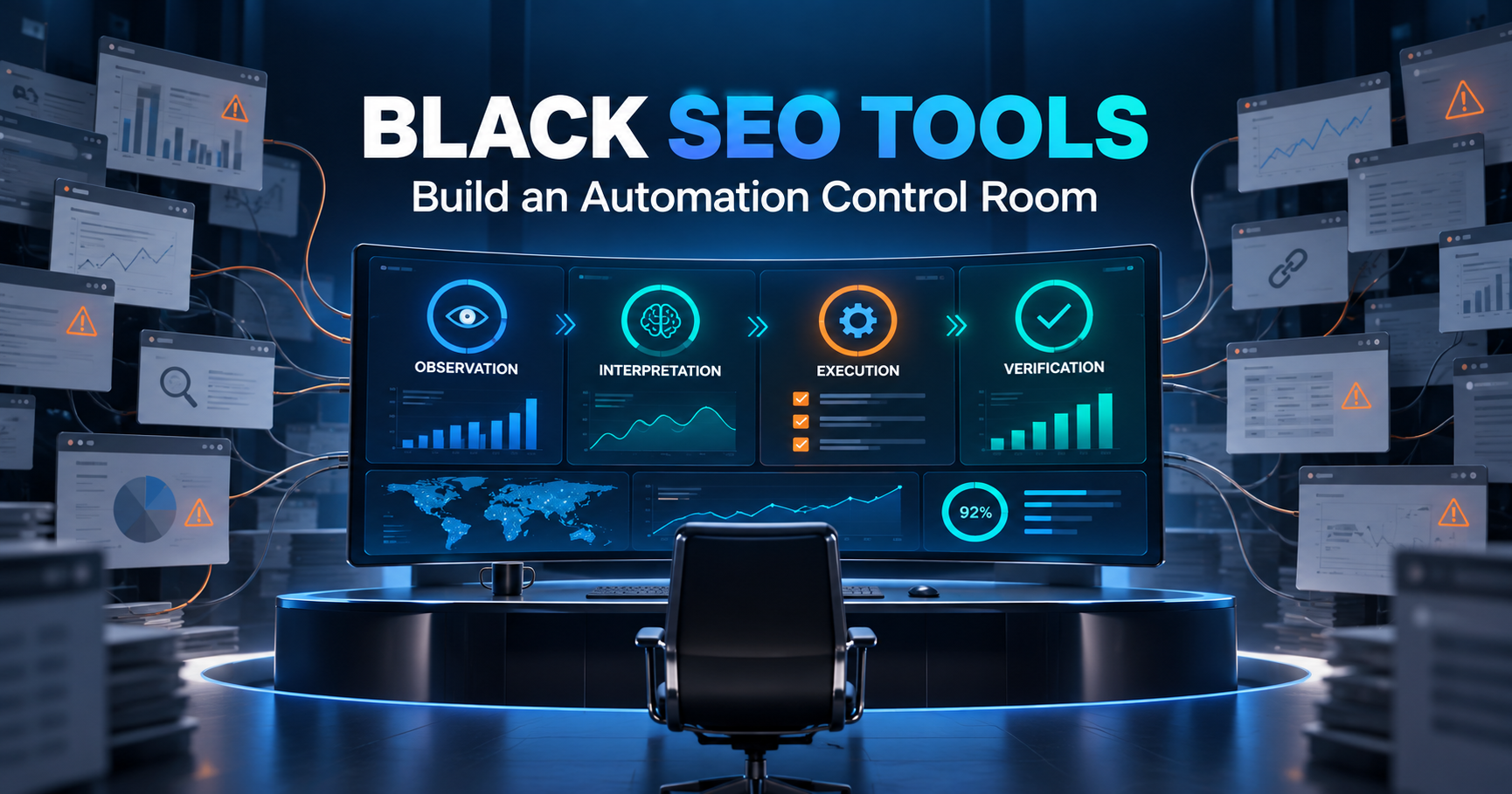
Businesses exploring BlackHat SEO Tools should build an automation control room—a system that connects data, decisions, actions and results—rather than collecting disconnected software.
What Are Black SEO Tools?
The term black SEO tools generally refers to software used for aggressive, experimental or highly automated search optimisation. Depending on the application, these tools may support:
- Website crawling
- Keyword discovery
- Competitor monitoring
- Backlink analysis
- Content generation
- Expired-domain research
- Rank tracking
- Page publishing
- Redirect monitoring
- Search-result analysis
A tool is not automatically harmful because it offers automation. Risk depends on how it is configured, what it produces and whether a human reviews its output.
For example, software that finds broken links can support a legitimate website audit. The same software becomes problematic when used to create thousands of irrelevant links without permission.
The Tool-Stack Paradox
Adding more software should improve decision-making. In practice, it can create five new problems.
Conflicting Metrics
Different platforms may report different traffic, keyword and backlink numbers because they use separate databases and calculation methods.
Duplicate Alerts
Several tools may flag the same problem using different language, making one issue appear more serious than it is.
Unclear Ownership
A tool identifies a problem, but nobody is responsible for investigating or fixing it.
Automated Noise
Large websites can generate thousands of alerts. Important changes become difficult to distinguish from minor warnings.
Missing Business Context
Software can detect a ranking decline but may not know whether the affected keyword produces customers.
The solution is not necessarily to cancel every platform. It is to assign each tool a specific responsibility.
Design an SEO Automation Control Room
An automation control room organises tools according to the decisions they support.
Layer One: Observation
Observation tools collect information without changing the website.
They may monitor:
- Search impressions and clicks
- Indexing status
- Keyword positions
- Backlink changes
- Website availability
- Page speed
- Competitor activity
The purpose of this layer is to detect meaningful changes.
Layer Two: Interpretation
Interpretation tools help organise raw data into patterns.
They can:
- Group related queries
- Compare page performance
- Identify content overlap
- Classify backlinks
- Detect unusual ranking movement
- Connect technical issues with page groups
These tools suggest possible explanations, but their output should be treated as evidence—not a final conclusion.
Layer Three: Execution
Execution tools make or distribute changes. They may update pages, publish content, create redirects or manage outreach.
Because this layer can directly affect a website, it requires tighter controls.
Before Allowing Automated Execution
Confirm:
- Which URLs can be changed
- What information can be published
- Who approves the action
- How many actions can occur in one period
- How results will be monitored
- How the change can be reversed
Layer Four: Verification
Verification tools determine whether an action produced the intended outcome.
They should check:
- Whether the correct page was modified
- Whether search engines can access it
- Whether rankings or clicks changed
- Whether conversions improved
- Whether unexpected pages were affected
- Whether the original state can be restored
Without verification, automation produces activity without accountability.
Create a Signal-to-Action Matrix
A signal-to-action matrix prevents teams from reacting automatically to every alert.
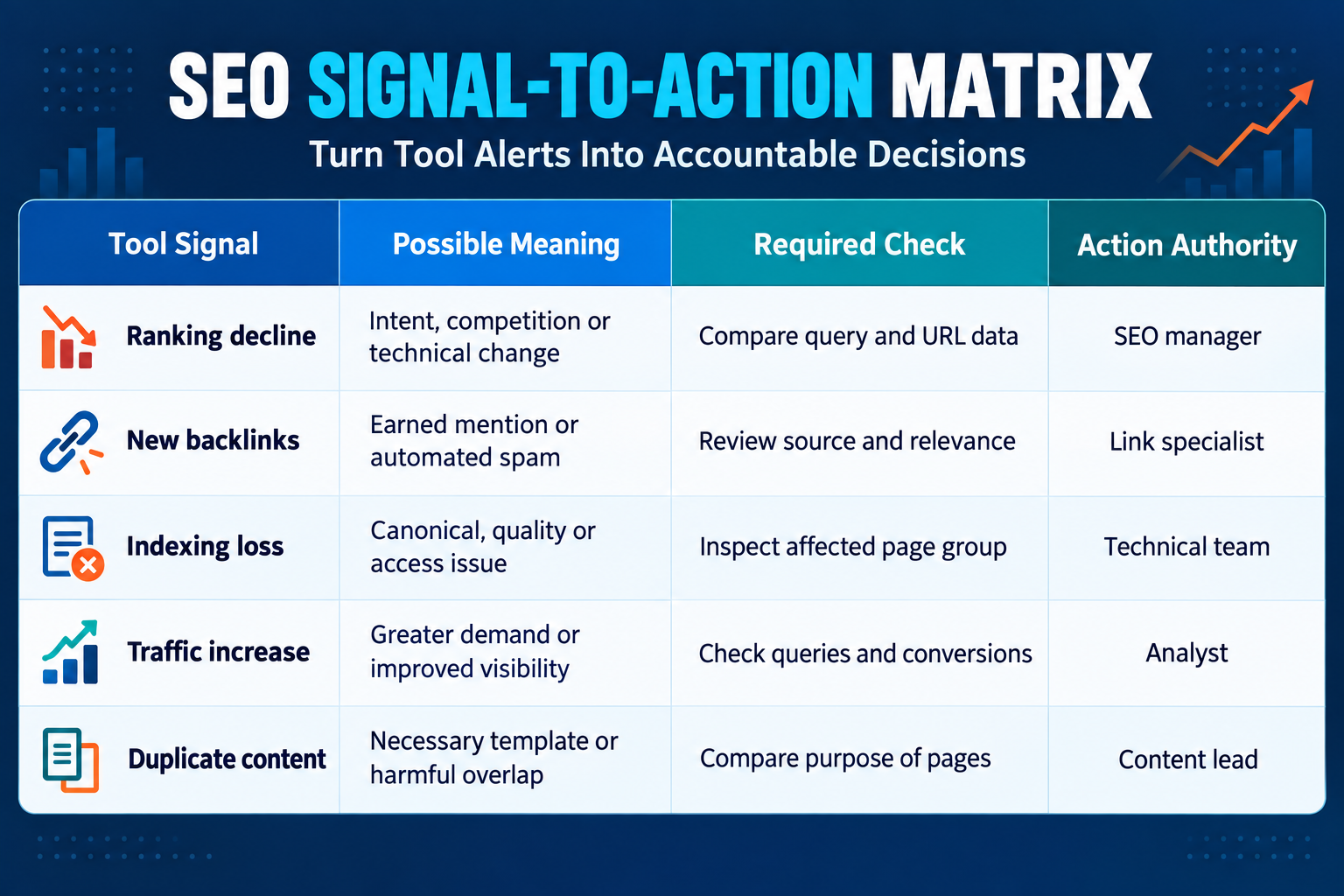
The matrix clarifies what happens after software identifies a condition.
Give Every Automation a Risk Budget
A risk budget defines how much exposure a business will accept during an experiment.
Low-Risk Automation
Examples include data collection, broken-link reports and keyword grouping. These actions observe or organise information without directly altering public assets.
Controlled Automation
This may include drafting metadata, suggesting internal links or preparing content briefs. Human approval should be required before publication.
High-Exposure Automation
Mass publishing, automatic redirects, bulk link creation and unsupervised account actions can affect rankings, reputation and ownership. These activities require strict limits—or should be avoided entirely.
Risk should be assessed using three questions:
- How widely can the action spread?
- How quickly can damage occur?
- Can every change be reversed?
Track Tool Decisions, Not Just Tool Usage
A software subscription is only valuable when it improves a decision.
Instead of reporting that a crawler analysed 10,000 pages, document:
- What important condition it found
- Which page group was affected
- What evidence confirmed the problem
- What decision was made
- What result followed
- Whether the tool’s recommendation was accurate
This creates a feedback loop that reveals which platforms genuinely support the business.
Prevent Tool-Generated Content Drift
AI and automation can gradually move content away from the website’s original purpose. This is known as content drift.
It may appear when:
- Articles target keywords unrelated to services
- Multiple pages answer the same question
- Brand facts become inconsistent
- Unsupported statistics are introduced
- Calls to action no longer match user intent
- AI-generated summaries repeat existing pages
A content-control process should compare every proposed page with the site’s keyword map, customer journey and verified business information.
Questions to Ask Before Choosing a Tool
Before investing in black SEO tools, ask:
- Which specific decision will this software improve?
- Does it observe, interpret, execute or verify?
- Can its data be exported?
- Who owns the account and stored information?
- Can automated actions be limited?
- Is human approval available?
- Can changes be logged and reversed?
- Does the tool expose its data sources and limitations?
- How will its value be measured after 90 days?
If these questions cannot be answered, the tool may create more operational complexity than SEO value.
FAQs
Can black SEO tools guarantee rankings?
No tool can guarantee a particular search position. Search results depend on competition, relevance, technical eligibility, user needs and changing search systems.
Is AI-generated SEO content safe?
AI can support research, organisation and drafting, but every output should be checked for accuracy, originality, relevance and compliance before publication.
How many SEO tools does a business need?
There is no universal number. A smaller tool stack with clear responsibilities is often more useful than several platforms producing overlapping reports.
Should tools automatically make website changes?
Only low-impact, reversible actions should be considered for controlled automation. Important public changes should require human review and approval.
Conclusion
The value of BlackHat SEO Tools does not come from how many keywords they discover, pages they generate or links they identify. Their value comes from helping people make better, faster and more accountable decisions.
Build an automation control room with clear observation, interpretation, execution and verification layers. Assign ownership, establish risk budgets and measure the quality of decisions created by each platform.
The strongest tool stack is not the largest. It is the one that turns reliable signals into controlled actions and measurable business results.