
Ranking a website has become more difficult. Search engines now evaluate content quality, user intent, technical performance, authority and brand trust together. Simply publishing articles or creating hundreds of backlinks no longer guarantees better visibility.
A professional Black Hat SEO Course should not teach students to copy risky tactics blindly. It should explain how search engines work, how ranking experiments are conducted and how potential risks can be evaluated before making changes to a website.
What Is a Black Hat SEO Course?
A Black Hat SEO Course is an advanced SEO learning program that studies aggressive, experimental or unconventional methods used to influence search rankings.
Topics may include:
- Search-engine crawling and indexing
- Advanced competitor research
- Backlink analysis
- Parasite SEO
- Expired-domain evaluation
- Content scaling
- Website-authority analysis
- Ranking experiments
- Automation tools
- Algorithm and penalty recovery
Some black hat techniques violate search-engine guidelines and can result in ranking loss, manual actions or removal from search results. Therefore, learners should study these methods for research and risk awareness—not apply them carelessly to important business websites.
Why Do People Want to Learn Advanced SEO?
Basic SEO courses often explain keyword research, title tags, content writing and link building. These fundamentals are necessary, but they may not answer difficult questions such as:
- Why did a page lose rankings despite having good content?
- Why is Google ranking a weaker competitor?
- Why are backlinks failing to improve performance?
- Why is a page crawled but not indexed?
- Why does traffic increase without generating enquiries?
- Why do third-party platforms rank faster than a business website?
An advanced Black Hat SEO Course should teach learners how to investigate these situations using evidence instead of assumptions.
Important Modules in a Black Hat SEO Course
1. Search Engine Fundamentals
Before testing advanced strategies, students must understand how search engines discover, process and rank webpages.
This module should cover:
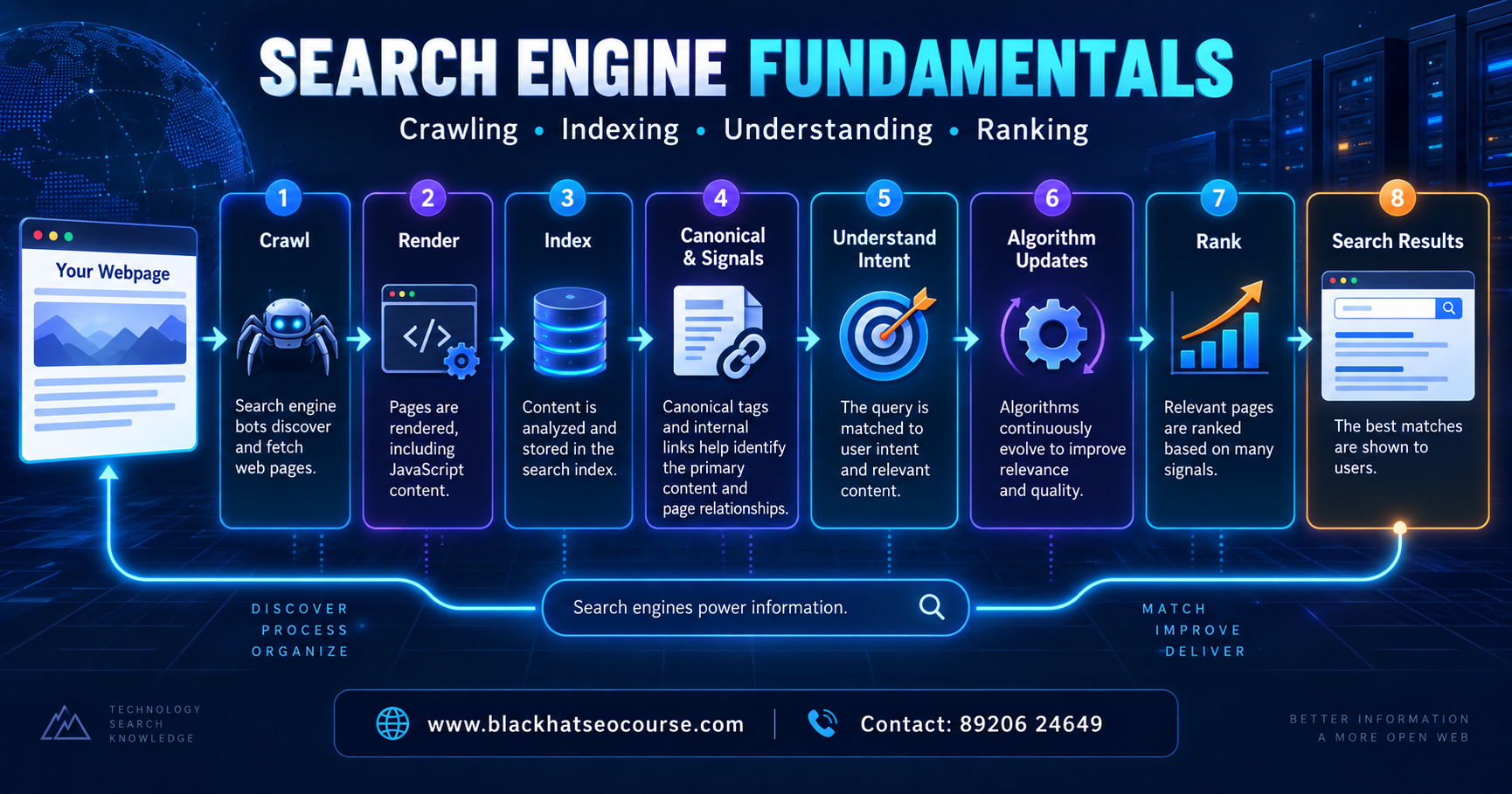
- Crawling and crawl budgets
- Indexing eligibility
- Canonical URLs
- Internal linking
- JavaScript rendering
- Search intent
- Ranking signals
- Algorithm updates
Without this foundation, learners may mistake technical problems for content or backlink problems.
2. Competitor and SERP Analysis
Competitor research is more than checking keywords and domain authority. Students should learn how to examine:
- The type of pages ranking for a query
- Content formats preferred by Google
- Competitors’ backlink sources
- Brand mentions and citations
- Internal-link structures
- Page freshness
- Location and language relevance
- Changes in search-result features
This analysis helps identify why certain pages are winning and what evidence is still missing.
3. Backlink Evaluation
Backlinks can support rankings, but poor-quality link building can create serious risks. A responsible course should explain how to assess:
- Website relevance
- Page-level context
- Link placement
- Anchor-text distribution
- Traffic quality
- Indexing status
- Outbound-link patterns
- Spam indicators
Students should also learn that submitting a link is not the same as earning ranking value. Search engines may ignore, devalue or distrust artificial links.
4. Parasite SEO and Third-Party Publishing
Parasite SEO involves publishing content on an established third-party platform to benefit from its existing authority. It may generate quick visibility, but the publisher does not control the platform.
The course should discuss:
- Platform selection
- Editorial rules
- Content ownership
- Link limitations
- Reputation risks
- Removal possibilities
- Brand consistency
- Traffic and conversion tracking
A strong strategy should never depend entirely on websites controlled by other companies.
5. SEO Testing and Documentation
Advanced SEO requires controlled testing. Changing content, backlinks, page structure and metadata simultaneously makes it difficult to identify what influenced performance.
Every experiment should record:
- The original condition
- The proposed change
- The expected outcome
- The affected pages
- The implementation date
- Ranking and traffic measurements
- Conversion results
- Reversal instructions
This process transforms random activity into measurable learning.
Understanding the Risks
A trustworthy Black Hat SEO Course must clearly explain the possible consequences of aggressive tactics.
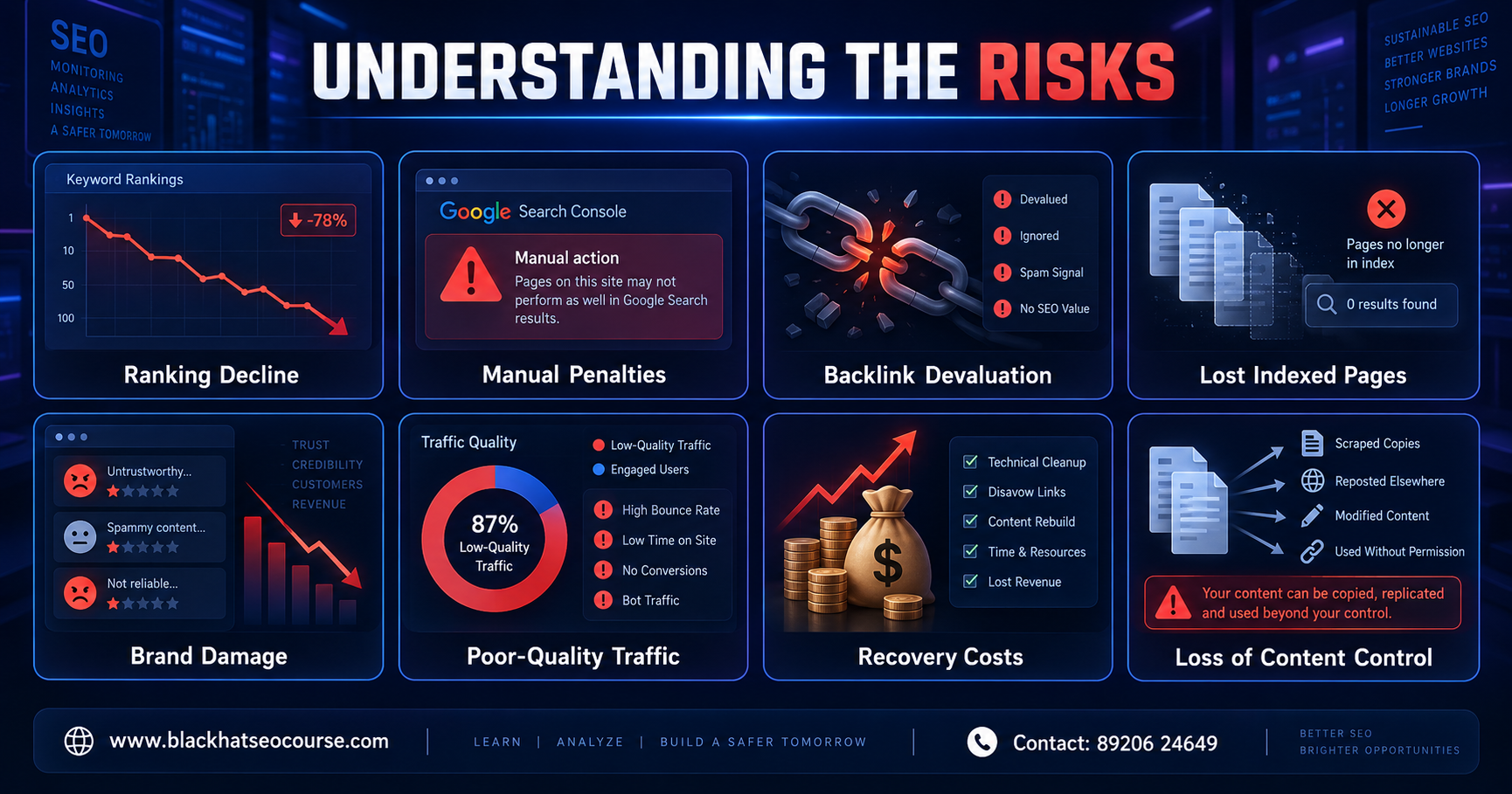
These may include:
- Sudden ranking decline
- Manual penalties
- Backlink devaluation
- Loss of indexed pages
- Brand reputation damage
- Poor-quality traffic
- Expensive recovery work
- Loss of control over published content
No instructor can guarantee permanent rankings. Search algorithms, competitors and user behaviour continually change.
How to Choose the Right Course
Before enrolling, ask the following questions:
- Does the course explain both techniques and risks?
- Are strategies supported by data or real testing?
- Does it cover technical SEO, content and backlinks?
- Are students taught to monitor results?
- Does it include recovery and reversal planning?
- Are legal, ethical and platform-related limitations discussed?
- Does the instructor avoid guaranteed-ranking promises?
Avoid courses that focus only on secret tools, automated submissions or large numbers of backlinks. Tools can collect data and automate tasks, but they cannot replace professional judgment.
Who Can Benefit from This Course?
A Black Hat SEO Course may be useful for:
- SEO executives
- Digital marketers
- Website owners
- Affiliate marketers
- Freelancers
- Agency professionals
- Students researching search algorithms
Beginners should first understand ethical SEO fundamentals before studying high-risk techniques.
Frequently Asked Questions
Is black hat SEO illegal?
Most black hat SEO techniques are not necessarily illegal, but they may violate search-engine or publishing-platform guidelines. Certain activities, such as hacking or unauthorized access, can have legal consequences.
Can black hat SEO guarantee fast rankings?
No. Some techniques may produce temporary movement, but no method can guarantee rankings or long-term stability.
Can beginners join a Black Hat SEO Course?
Beginners can study it, but they should first learn keyword research, on-page SEO, technical SEO, content strategy and ethical link building.
Is it safe to test these techniques on a business website?
High-risk experiments should not be performed directly on an important business website. Use isolated test properties, define limits and prepare a reversal plan.
Conclusion
A valuable Black Hat SEO Course should develop analytical thinking rather than encourage blind shortcuts. Learners must understand how search engines work, examine reliable evidence, test one variable at a time and measure business outcomes.
The real purpose of advanced SEO education is not to collect tactics. It is to make better decisions while understanding the potential consequences of every action.