
A customer may no longer type a short phrase and visit several websites to find an answer. Instead, they may ask a complete question and expect a direct response from Google, an AI assistant or a voice-search tool.
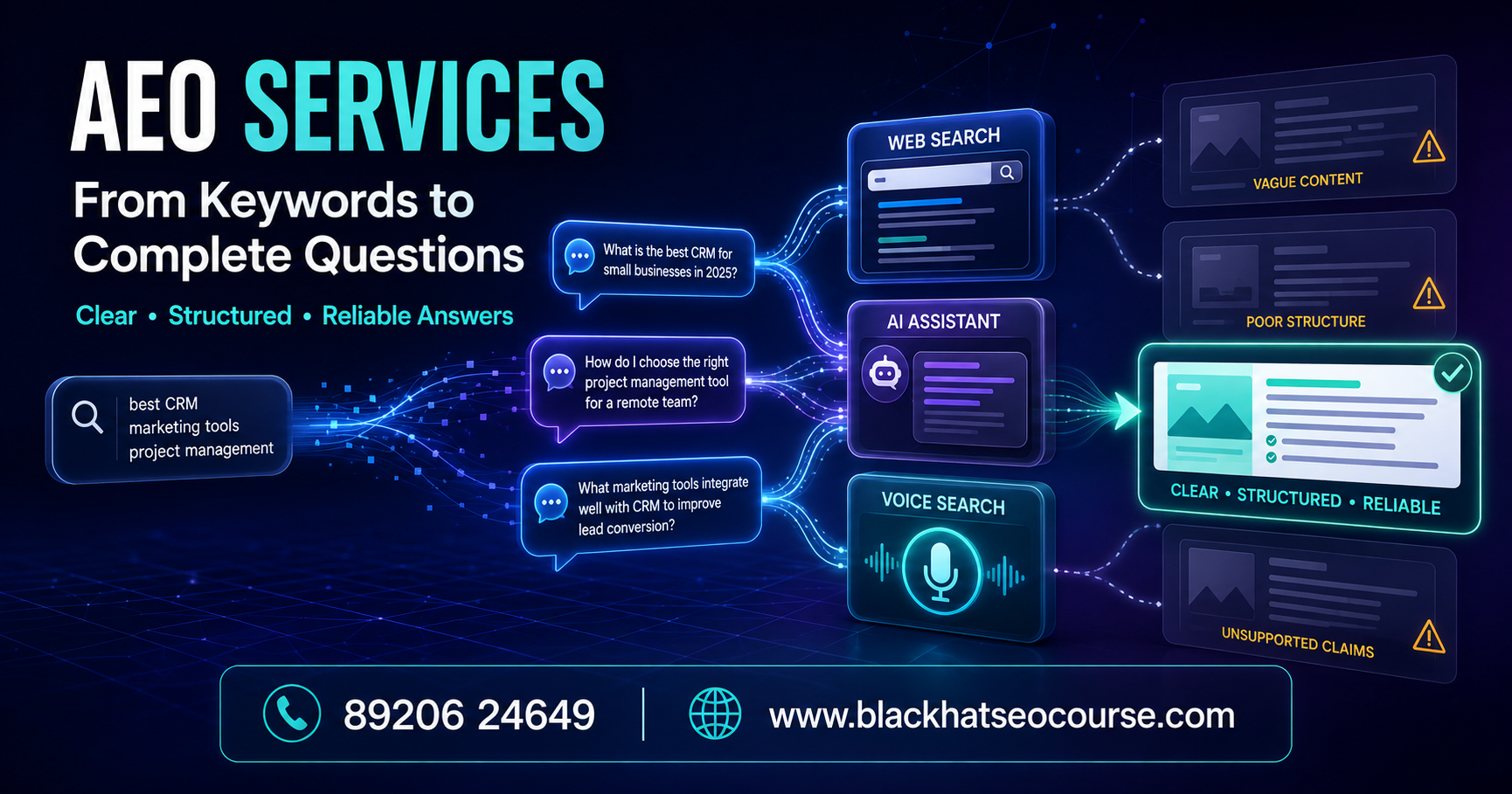
This shift creates a new challenge for businesses. Their websites may contain valuable information, but search and AI systems can overlook it when the content is vague, poorly structured or unsupported.
Professional AEO Services organise business knowledge into clear, reliable answers that people and automated systems can understand.
Quick answer: AEO services help businesses discover customer questions, write direct answers, clarify topics and entities, implement suitable structured data and measure visibility across traditional and AI-assisted search.
What Are AEO Services?
AEO stands for Answer Engine Optimisation. It improves content so that answer-driven systems can find, interpret and retrieve useful information.
AEO services may include:
- Question and search-intent research
- Existing-content audits
- Direct-answer writing
- Content restructuring
- Entity clarification
- FAQ development
- Internal linking
- Structured data
- Technical crawlability checks
- Source verification
- Performance measurement
AEO does not replace SEO. A page must still be crawlable, indexable, useful and technically reliable before it can compete for answer visibility.
AEO vs Traditional SEO
| Area | Traditional SEO | AEO |
|---|---|---|
| Main objective | Improve organic visibility | Make answers easier to retrieve |
| Typical query | Short keyword | Complete question |
| Common format | Articles and landing pages | Direct answers, tables and steps |
| Technical foundation | Crawling and indexing | Crawling, indexing and structured clarity |
| Key measurement | Rankings, clicks and traffic | Answer visibility, mentions and conversions |
| Main value | Helps people discover a page | Helps systems understand its answers |
The two approaches work best together.
1. Research Real Customer Questions
Effective AEO begins with genuine questions rather than invented keyword variations.
Useful sources include:
- Google Search Console
- Customer-support conversations
- Sales calls
- Website searches
- Product reviews
- Community discussions
- Competitor-content gaps gaps
Prioritise questions that help users understand a problem, evaluate a choice or complete an action.
2. Match Questions with Search Intent
Questions normally fall into four groups:
- Informational: What does the service mean?
- Comparison: How is one option different from another?
- Troubleshooting: Why is something not working?
- Transactional: What does the service include and how can I begin?
Avoid answering every question on one page. Group related questions and assign them to the most relevant article, service or support page.
3. Place the Answer Near the Question
Readers should not have to move through a long introduction before finding the answer.
Use a clear heading followed by a direct response. Supporting details, examples and limitations can appear afterwards.
There is no required answer length. The response should be concise without removing information necessary for accuracy.
4. Write Self-Contained Answers
An answer should make sense when shown separately from the full article.
Weak answer:
“It helps improve visibility on these platforms.”
Improved answer:
“Answer Engine Optimisation structures website content so search engines, voice assistants and AI-powered systems can identify and retrieve accurate responses to user questions.”
The second version defines the subject and explains the benefit without depending on previous paragraphs.
5. Use Scannable Content Formats
Answer-focused content may include:
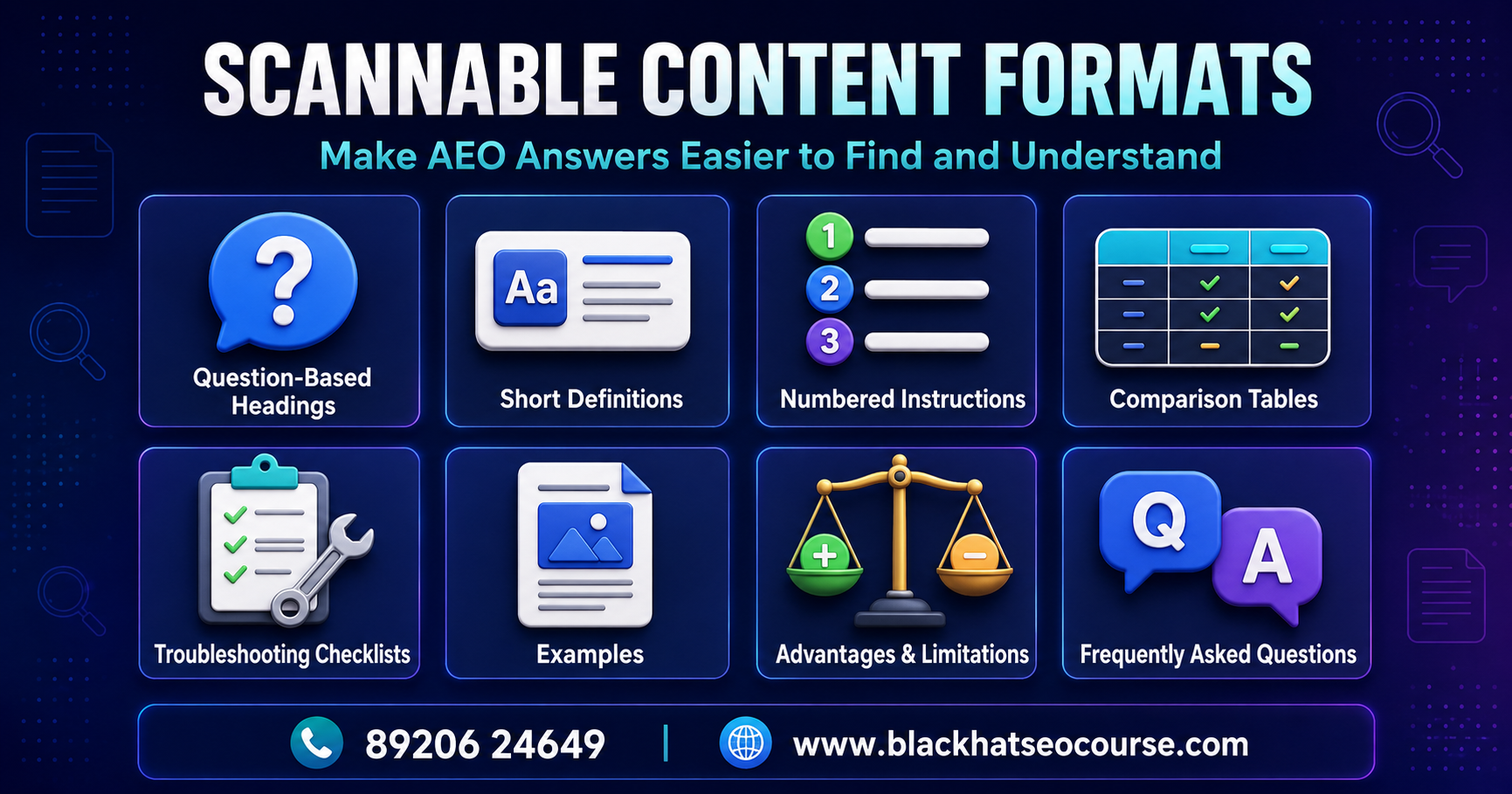
- Question-based headings
- Short definitions
- Numbered instructions
- Comparison tables
- Troubleshooting checklists
- Examples
- Advantages and limitations
- Frequently asked questions
These formats help readers locate information quickly while making relationships between facts clearer.
6. Add Evidence and Original Value
Hundreds of pages can provide the same basic definition. A website needs something more useful if it wants to earn attention.
Original value may include:
- First-hand observations
- Real customer questions
- SEO experiments
- Process templates
- Audit checklists
- Expert commentary
- Original research
- Clearly explained case studies
When presenting a case study, state the timeframe, method and limitations. Do not invent statistics or imply that one result will apply to every website.
7. Make Expertise Visible
Readers should be able to identify who created the content and why they are qualified to discuss it.
Add:
- Author name
- Relevant professional experience
- Publication date
- Genuine review date
- Reliable sources
- Editorial policy
- Correction process
Expertise should be demonstrated through accurate explanations and original insight—not unsupported labels such as “industry-leading.”
8. Clarify Business and Topic Entities
Answer systems should be able to understand the business, author, service and subject being discussed.
Use consistent:
- Brand names
- Service descriptions
- Author profiles
- Contact information
- Location details
- Product names
- Internal links
An accurate About page, service pages, contact information and author profiles can reduce confusion about who provides the information.
9. Implement Relevant Structured Data
Structured data helps search engines understand certain types of page information. Depending on the content, supported formats may include:
- Article
- Organization
- LocalBusiness
- Product
- Video
- Breadcrumb
- Event
The markup must accurately match information that visitors can see. Adding schema does not guarantee a featured result, AI answer or citation.
FAQ sections remain valuable when they answer genuine questions, even if they do not receive a special search-result display.
10. Measure Business Results
AEO performance cannot be evaluated using one metric.
Monitor:
- Question-based impressions
- Organic clicks
- Click-through rate
- Featured-answer visibility
- Branded searches
- Relevant referral traffic
- Engagement
- Leads or enquiries
- Assisted conversions
- Sales from informational journeys
If impressions rise but clicks decline, determine whether the search result answers the question completely or whether the title provides no reason to visit.
Offer additional value—such as a calculator, template, checklist, detailed process or personalised consultation—that cannot be delivered fully within a short answer.
Before and After AEO Optimisation
Before:
“Our SEO audit provides excellent website solutions.”
After:
“An SEO audit evaluates crawling, indexing, page performance, content relevance, internal links and conversion barriers. The findings are organised into a prioritised action plan.”
The revised answer is stronger because it explains what is checked and what the customer receives.
How an AEO Campaign Works
- Collect real customer questions.
- Group questions by intent.
- Identify pages already receiving impressions.
- Assign each question to the correct page.
- Write a clear, direct answer.
- Add evidence, examples and limitations.
- Improve headings and internal links.
- Implement suitable structured data.
- Check crawling and indexing.
- Measure visibility, clicks and conversions.
Is Your Content Ready for Answer Engines?
Before publishing, ask:
- Is the main question immediately clear?
- Does a direct answer follow the heading?
- Can the answer make sense independently?
- Is the information accurate and current?
- Does the page provide original value?
- Are sources placed near important claims?
- Is the author identified?
- Can search engines access the page?
- Does structured data match visible content?
- Is there a useful next step for the reader?
How BlackHatSEOCourse.com Supports AEO
BlackHatSEOCourse.com provides AEO, SEO and GEO guidance for businesses seeking better visibility across search and AI-assisted experiences.
Its AEO approach may include question research, content restructuring, semantic topic development, technical crawlability checks, internal-link improvement and suitable structured data.
The purpose is to make genuine business knowledge easier to discover and understand. No provider can guarantee inclusion in AI-generated answers because search and AI platforms choose the sources they display.
Frequently Asked Questions
Can AEO guarantee inclusion in AI answers?
No. AEO can improve content clarity and eligibility, but it cannot guarantee that an answer engine will select or cite a particular website.
Does every business need AEO services?
Businesses with complex services, frequent customer questions or strong informational competition may benefit most. Basic content and technical problems should still be corrected first.
Are FAQs necessary for AEO?
No. FAQs are useful, but comparison tables, definitions, guides and troubleshooting pages can also provide answer-friendly information.
How long does AEO take?
There is no fixed timeframe. The page must be crawled and indexed, and performance depends on competition, authority, accuracy and search demand.
Conclusion
Effective AEO Services transform business knowledge into answers that are clear, accurate and easy to retrieve. The process combines customer-question research, structured writing, original evidence, technical SEO and careful measurement.
The objective is not simply to appear in an AI response. It is to build dependable visibility and give users a meaningful reason to engage with the business.
Is Your Website Ready for Answer-Driven Search?
Identify one important customer question and review how clearly your website answers it. If the answer is difficult to locate, vague or unsupported, it is a strong starting point for AEO improvement.
Visit BlackHatSEOCourse.com to explore professional AEO, SEO and GEO strategies for modern search visibility.